Footprints of supply
Liu, Y., Shi, S., Gaston, K.J., Mueller, M. & Yan, X. 2025. Global environmental footprints of electricity supply in China. Journal of Cleaner Production 520, 146164.
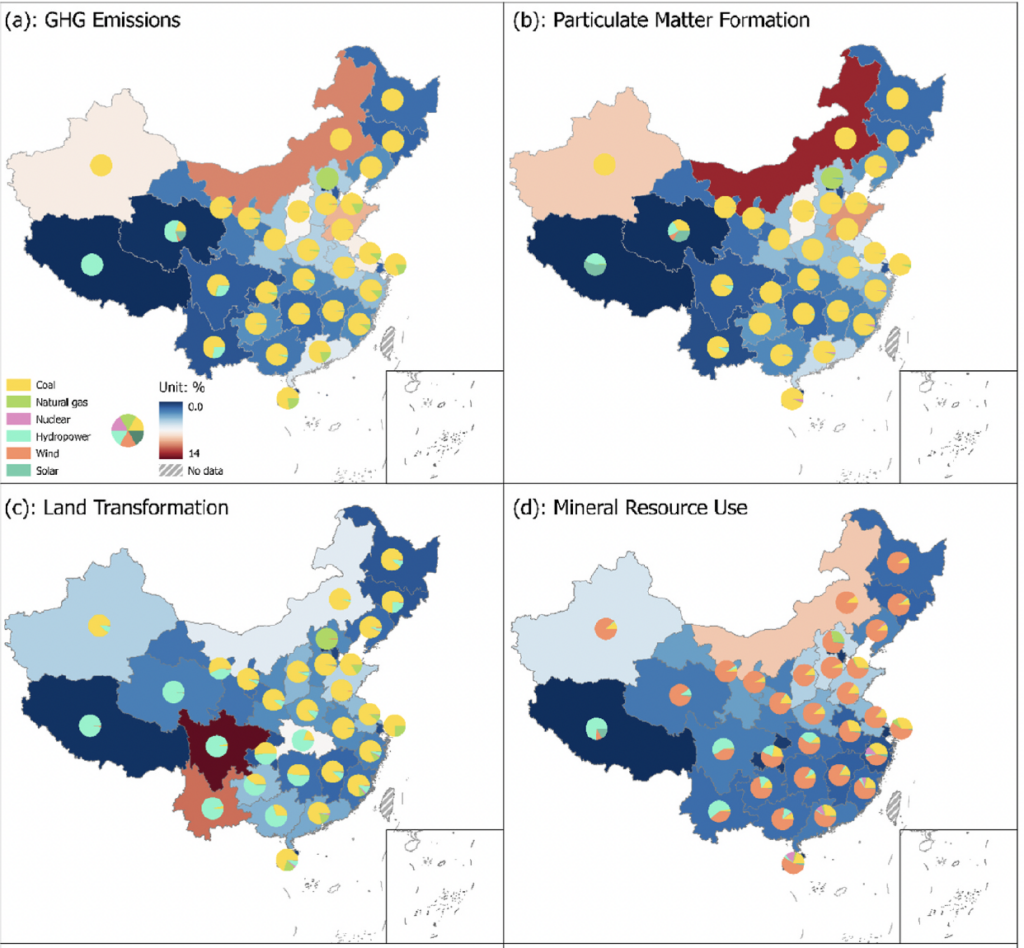
Electricity generation is a major contributor to environmental impacts. However, a holistic yet detailed understanding of the cumulative environmental consequences of China’s current electricity system, the world’s largest, is still lacking. Using spatially explicit life cycle assessment, this study analysed the magnitude and global spatial distribution of a wide range of environmental footprints of China’s total electricity supply from six main power technologies (coal, gas, wind, solar, nuclear and hydropower). Greenhouse Gas Emissions, Particulate Matter Formation, Freshwater Eutrophication, Mineral Resource Use and Land Transformation were found to be 5.5 Gt CO2 eq, 1.4 Mt PM2.5 eq, 1.8 kt PO4 P-lim eq, 6.2 Mt mineral deprived and 387 km2 arable land eq, respectively. Coal contributed most to four impact categories, accounting for 93% of Greenhouse Gas Emissions, 95% of Particulate Matter Formation, 63% of Freshwater Eutrophication and 50 % of Land Transformation. In contrast, wind contributed most (58%) to Mineral Resource Use and hydropower contributed 40% of Land Transformation. The spatial distribution suggests that 99% of Greenhouse Gas Emissions and 96% of Particulate Matter Formation were within China while 58% of Land Transformation of coal and 63% of Freshwater Eutrophication of solar were widely distributed globally outside of China. These findings suggest that local, national and international policymakers should integrate full life cycle environmental footprints of power systems and their spatial distribution into decision making and establish strategies that can more effectively mitigate the impacts or avoid impact shifting across different countries, sectors and impact categories.