
Anderson, K., Hancock, S. Casalegno, S., Griffiths, A., Griffiths, D., Sargent, F., McCallum, J., Cox, D.T.C. & Gaston, K.J. 2018. Visualising the urban green volume: Exploring LiDAR voxels with tangible technologies and virtual models. Landscape and Urban Planning 178, 248-260. 
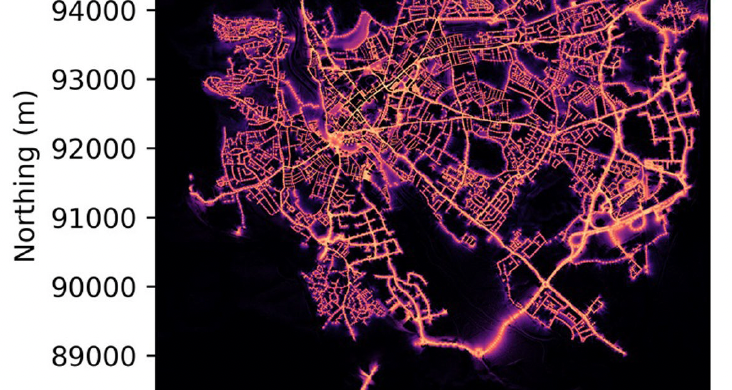
The distribution of vegetation within urban zones is well understood to be important for delivery of a range of ecosystem services. While urban planners and human geographers are conversant with methodologies for describing and exploring the volumetric nature of built spaces there is less research that has developed imaginative ways of visualising the complex spatial and volumetric structure of urban vegetation from the treetops to the ground. Using waveform LiDAR data to measure the three-dimensional nature of the urban greenspace, we explore different ways of virtually, and tangibly engaging with volumetric models describing the 3D distribution of urban vegetation. Using waveform LiDAR data processed into voxels (volumetric pixels) and experimenting with a variety of creative approaches to visualise the volumetric nature of the data, we describe the development of new methods for mapping the urban green volume, using a combination of Geographic Information Systems (GIS), Minecraft, 3D printing and Computer Numerical Control (CNC) milling processes. We demonstrate how such methodologies can be used to reveal and explore the complex nature of the urban green volume. We also describe the outcome of using these models to engage diverse audiences with the volumetric data. We explain how the products could be used readily by a range of urban researchers and stakeholders: from town and city councils, to architects and ecologists.

 So, you have a great idea for a new paper. It looks at some aspect of the interactions between people and nature. It will have some ecological relevance, but may not be a pure ecology paper. It will also have a good bit of material drawn from one or more other disciplines – it could be economics, geography, history, law, literature, medicine, philosophy, politics, psychology, or sociology, to name just a few possibilities. But it is not a mainstream paper for one of those disciplines either. So, where will you submit your latest contribution? You will want a journal that not just considers outputs from this kind of cross/multi/interdisciplinary work, but really values them. You will want one that understands both the importance of your paper being promptly and fairly handled by people who are knowledgeable about the topic, and that takes seriously the challenges that can arise when reviewing work that crosses disciplinary specialisms. You will want one backed by a respected organisation, with a track record of publishing high quality journals.


