Valuing the natural world

Dallimer, M., Tinch, D., Hanley, N., Irvine, K.N., Rouquette, J.R., Warren, P.H., Maltby, L., Gaston, K.J. & Armsworth, P.R. 2014. Quantifying preferences for the natural world using monetary and non-monetary assessments of value. Conservation Biology 28, 404-413.IMG_1085

Given that funds for biodiversity conservation are limited, there is a need to understand people’s preferences for its different components. To date, such preferences have largely been measured in monetary terms. However, how people value biodiversity may differ from economic theory, and there is little consensus over whether monetary metrics are always appropriate or the degree to which other methods offer alternative and complementary perspectives on value. We used a choice experiment to compare monetary amounts recreational visitors to urban green spaces were willing to pay for biodiversity enhancement (increases in species richness for birds, plants, and aquatic macroinvertebrates) with self-reported psychological gains in well-being derived from visiting the same sites. Willingness-to-pay (WTP) estimates were significant and positive, and respondents reported high gains in well-being across three axes derived from environmental psychology theories (reflection, attachment, continuity with past). The two metrics were broadly congruent. Participants with abovemedian self-reported well-being scores were willing to pay significantly higher amounts for enhancing species richness than those with below-median scores, regardless of taxon. The socio-economic and demographic background of participants played little role in determining either their well-being or the probability of choosing a paying option within the choice experiment. Site-level environmental characteristics were only somewhat related to WTP, but showed strong associations with self-reported well-being. Both approaches are likely to reflect a combination of the environmental properties of a site and unobserved individual preference heterogeneity for the natural world. Our results suggest that either metric will deliver mutually consistent results in an assessment of environmental preferences, although which approach is preferable depends on why one wishes to measure values for the natural world.


Limits on urban squirrels

Bonnington, C., Gaston, K.J. & Evans, K.L. 2014. Squirrels in suburbia: influence of urbanisation on occurrence and distribution of a common exotic mammal. Urban Ecosystems 17, 533-546.DSCN0147

Urbanisation is widely considered to promote the establishment of non-native species, but there is limited empirical evidence of the ecological factors driving their responses. The grey squirrel Sciurus carolinensis (Gmelin 1788) is native to North America, but is widespread in the UK and is starting to spread across Europe. It is regarded as one of the world’s worst invasive animals due to its adverse impacts on native biodiversity. We use the non-native grey squirrel population in Sheffield (UK) as a case study to assess which factors limit its distribution and abundance in urban environments. In 2010 the city-wide population of adult squirrels peaked at an estimated 6539 in autumn (0.46 squirrels/ha), with maximum local densities of 8.29/ha. These densities appear to be slightly lower than those recorded in urban environments in the species’ native range. Grey squirrels occurred more frequently at urban sites with larger amounts of green-space in the surrounding region. Local habitat characteristics were, however, more powerful predictors of urban grey squirrel occurrence and abundance than regional availability of green space. Canopy cover, seed bearing trees and supplementary feeders, provided for garden birds, positively influenced grey squirrels. The potential for grey squirrels to connect city dwellers with nature thus appears to be highest in urban locations that have considerable capacity to support native biodiversity. The beneficial impacts of supplementary feeding on grey squirrel populations is notable given concerns that squirrels can adversely influence bird populations. These habitat associations also imply that grey squirrels typically respond negatively to urbanisation, which challenges arguments that urbanisation favours exotic species.


Squirrels on the feeders

Bonnington, C., Gaston, K.J. & Evans, K.L. 2014. Assessing the potential for Grey squirrels Sciurus carolinensis to compete with birds at supplementary feeding stations. Ibis 156, 220-226.DSCN0149

Supplementary feeding of birds, particularly in urban areas, is often associated with increased population size and fecundity. In the UK, the non-native Grey Squirrel Sciurus carolinensis is common in rural and urban habitats. It exploits supplementary feeders and may induce interference competition by excluding birds, but empirical evidence of this is unavailable. Using controlled model presentation experiments, we demonstrate that Grey Squirrels could reduce bird use of supplementary feeders and induce interference competition. Total bird resource use was reduced by 98% and most species exhibited similar sensitivities. The likelihood and magnitude of interference competition will depend on how rapidly displaced birds find alternative food sources; it will be greatest where there are high Grey Squirrel densities and few supplementary feeders. Other studies suggest that supplementary feeding increases Grey Squirrel numbers, and the species is also predicted to expand its non-native range across most of Europe. Our data indicate that Grey Squirrels may eventually alter the net effect of supplementary feeding on bird populations across the European continent; increased use of squirrelproof feeders may help to minimize such effects.


Brightening and darkening of Europe

Bennie, J., Davies, T., Duffy, J., Inger, R. & Gaston, K.J. 2014. Contrasting trends in light pollution across Europe. Scientific Reports 4, 3789.

Screen Shot 2014-06-13 at 14.38.47Since the 1970s nighttime satellite images of the Earth from space have provided a striking illustration of the extent of artificial light. Meanwhile, growing awareness of adverse impacts of artificial light at night on scientific astronomy, human health, ecological processes and aesthetic enjoyment of the night sky has led to recognition of light pollution as a significant global environmental issue. Links between economic activity, population growth and artificial light are well documented in rapidly developing regions. Applying a novel method to analysis of satellite images of European nighttime lights over 15 years, we show that while the continental trend is towards increasing brightness, some economically developed regions show more complex patterns with large areas decreasing in observed brightness over this period. This highlights that opportunities exist to constrain and even reduce the environmental impact of artificial light pollution while delivering cost and energy-saving benefits.

Download pdf


Mapping lights for ecology

Bennie, J., Davies, T. W., Inger, R. and Gaston, K. J. (2014), Mapping artificial lightscapes for ecological studies. Methods in Ecology and Evolution, 5: 534–540. doi:10.1111/2041-210X.12182

  1. Artificial illumination of the night is increasing globally. There is growing evidence of a range of ecological impacts of artificial light and awareness of light pollution as a significant environmental issue. In urban and suburban areas, complex spatial patterns of light sources, structures and vegetation create a highly heterogeneous night-time light environment for plants and animals.
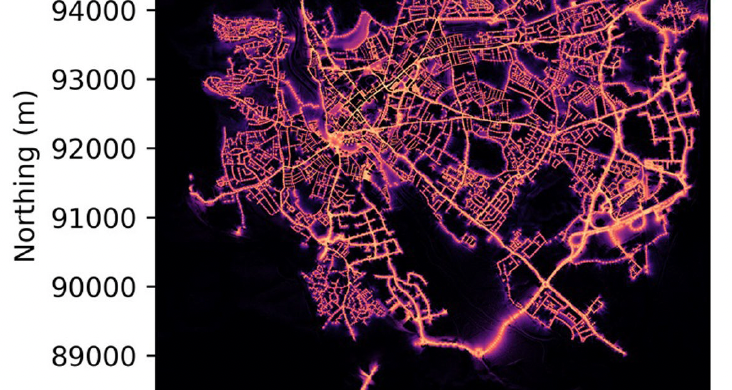
  2. We developed a method for modelling the night-time light environment at a high spatial resolution in a small urban area for ecological studies. We used the position and height of street lights, and digital terrain and surface models, to predict the direct light intensity at different wavelengths at different heights above the ground surface.
  3. Validation against field measurements of night-time light showed that modelled light intensities in the visible and ultraviolet portions of the spectrum were accurate.
  4. We show how this model can be used to map biologically relevant lightscapes across an urban landscape. We also illustrate the utility of the model using night-time light maps as resistance surfaces in the software package CIRCUITSCAPE to predict potential movement of model nocturnal species between habitat patches and to identify key corridors and barriers to movement and dispersal.
  5. Understanding the ecological effects of artificial light requires knowledge of the light environment experienced by organisms throughout the diurnal and annual cycles, during periods of activity and rest and during different life stages. Our approach to high-resolution mapping of artificial lightscapes can be adapted to the sensitivity to light of different species and to other urban, suburban, rural and industrial landscapes.

Download pdf


Demographic effects of artificial nighttime lighting on animal populations

Gaston, Kevin J., and Jonathan Bennie. “Demographic effects of artificial nighttime lighting on animal populations.” Environmental Reviews 22.4 (2014): 323-330.

Artificial lighting, especially but not exclusively through street lights, has transformed the nighttime environment in much of the world. Impacts have been identified across multiple levels of biological organization and process. The influences, however, on population dynamics, particularly through the combined effects on the key demographic rates (immigration, births, deaths, emigration) that determine where individual species occur and in what numbers, have not previously been well
characterized. The majority of attention explicitly on demographic parameters to date has been placed on the attraction of organisms to lights, and thus effectively local immigration, the large numbers of individuals that can be involved, and then to some extent the mortality that can often result. Some of the most important influences of nighttime lighting, however, are likely more subtle and less immediately apparent to the human observer. Particularly significant are effects of nighttime lighting on demography that act through (i) circadian clocks and photoperiodism and thence on birth rates; (ii) time partitioning and thence on death rates; and (iii) immigration/emigration through constraining the movements of individuals amongst habitat networks, especially as a consequence of continuously lit linear features such as roads and footpaths. Good model organisms are required to enable the relative consequences of such effects to be effectively determined, and a wider consideration of the effects of
artificial light at night is needed in demographic studies across a range of species.

Download pdf


Biogeography of time partitioning in mammals

Bennie, J. J., Duffy, J. P., Inger, R., & Gaston, K. J. (2014). Biogeography of time partitioning in mammals. Proceedings of the National Academy of Sciences, 111(38), 13727-13732. doi: 10.1073/pnas.1216063110

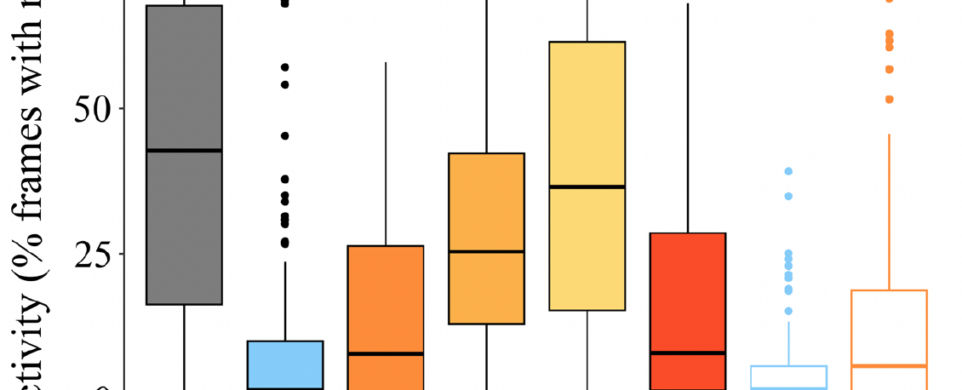
Many animals regulate their activity over a 24-h sleep–wake cycle, concentrating their peak periods of activity to coincide with the hours of daylight, darkness, or twilight, or using different periods of light and darkness in more complex ways. These behavioral differences, which are in themselves functional traits, are associated with suites of physiological and morphological adaptations with implications for the ecological roles of species. The biogeography of diel time partitioning is, however, poorly understood.


Here, we document basic biogeographic patterns of time partitioning by mammals and ecologically relevant large-scale patterns of natural variation in “illuminated activity time” constrained by temperature, and we determine how well the first of these are predicted by the second. Although the majority of mammals are nocturnal, the distributions of diurnal and crepuscular species richness are strongly associated with the availability of biologically useful daylight and twilight, respectively. Cathemerality is associated with relatively long hours of daylight and twilight in the northern Holarctic region, whereas the proportion of nocturnal species is highest in arid regions and lowest at extreme high altitudes. Although thermal constraints on activity have been identified as key to the distributions of organisms, constraints due to functional adaptation to the light environment are less well studied. Global patterns in diversity are constrained by the availability of the temporal niche; disruption of these constraints by the spread of artificial lighting and anthropogenic climate change, and the potential effects on time partitioning, are likely to be critical influences on species’ future distributions.

Download pdf


Vertebrates and protected areas

Cantú-Salazar, L., Orme, C.D.L., Rasmussen, P.C., Blackburn, T.M. & Gaston, K.J. 2013. The performance of the global protected area system in capturing vertebrate geographic ranges. Biodiversity and Conservation 22, 1033-1047.

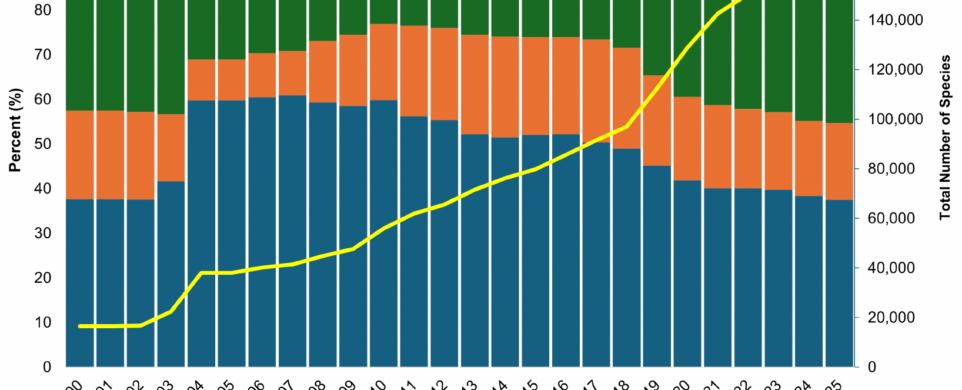
Given the heavy reliance placed on and investment in protected areas for biological conservation, there has been much debate as to how effective these are in representing biodiversity features within their boundaries. The majority of studies addressing this issue have been conducted on a regional or national basis, precluding a broad picture of patterns of representation at the species level. We present a global assessment of the representation of the terrestrial geographic ranges of complete taxonomic groups: all known extant amphibians, birds and mammals (20,736 species) within the current global system of protected areas. We conclude that it is necessary substantially to improve the levels of coverage of the geographic ranges of the majority of species, even the widespread ones. This is particularly true for rare species, which might be assumed to be foci for protected area systems. To improve on the low levels of coverage of vertebrate ranges attained by the existing areas, key regions should be targeted, but heavy reliance will also have to be placed on approaches to sustaining populations in the wider, unprotected landscape.


Unmanned aerial vehicles

Anderson, K. & Gaston, K.J. 2013. Lightweight unmanned aerial vehicles will revolutionize spatial ecology. Frontiers in Ecology and Environment 11, 138-146.

Ecologists require spatially explicit data to relate structure to function. To date, heavy reliance has been placed on obtaining such data from remote-sensing instruments mounted on spacecraft or manned aircraft, although the spatial and temporal resolutions of the data are often not suited to local-scale ecological investigations. Recent technological innovations have led to an upsurge in the availability of unmanned aerial vehicles (UAVs) – aircraft remotely operated from the ground – and there are now many lightweight UAVs on offer at reasonable costs. Flying low and slow, UAVs offer ecologists new opportunities for scale-appropriate measurements of ecological phenomena. Equipped with capable sensors, UAVs can deliver fine spatial resolution data at temporal resolutions defined by the end user. Recent innovations in UAV platform design have been accompanied by improvements in navigation and the miniaturization of measurement technologies, allowing the study of individual organisms and their spatiotemporal dynamics at close range.


Altering light cycles

Davies, T.W., Bennie, J., Inger, R., & Gaston, K.J. 2013. Artificial light alters natural regimes of night-time sky brightness. Scientific Reports 3, 1722.

Artificial light is globally one of the most widely distributed forms of anthropogenic pollution.

However, while both the nature and ecological effects of direct artificial lighting are increasingly well documented, those of artificial sky glow have received little attention.We investigated how city lights alter natural regimes of lunar sky brightness using a novel ten month time series of measurements recorded across a gradient of increasing light pollution. In the city, artificial lights increased sky brightness to levels six times above those recorded in rural locations, nine and twenty kilometers away. Artificial lighting masked natural monthly and seasonal regimes of lunar sky brightness in the city, and increased the number and annual regime of full moon equivalent hours available to organisms during the night. The changes have potentially profound ecological consequences.

Download pdf