Pettorelli, N., Gaston, K.J., Barlow, J., Araújo, M.B., da Cunha Bustamante, M.M., Chown, S.L., Diele-Viegas, L.M., Laurance, W.F., Lees, A.C., Melo, F.P.L., Milner-Gulland, E.J., Pecl, G. & Sousa-Pinto, I. 2025. Six actions for ecologists in times of planetary crisis. Nature Ecology and Evolution 9, 1300-1301.
Being an ecologist in challenging times
Loss of ecological experience
Soga, M. & Gaston, K.J. 2025. Extinction of experience among ecologists. Trends in Ecology and Evolution 40, 212-215.
Fieldwork-based research and education in ecology are under multiple threats and are progressively declining. We call for greater attention to this ongoing loss of direct field experience within the ecology community, as it could have widespread consequences for science and education, ultimately hindering efforts to address the ongoing biodiversity crisis.
Planning for renewing nature

Baker, D.J., Gaston, K.J., Metcalfe, K. & Maclean, I.M.D. 2025. Systematic conservation planning for nature recovery. BioScience 75, 472-489.
Nature conservation is increasingly focused on recovering depleted populations and ecosystems. The United Nations General Assembly has proclaimed 2021–2030 the UN Decade on Ecosystem Restoration, and global commitments to ecosystem restoration in response to biodiversity, climate, and sustainable development targets are now considerable, with over 100 nations committed to halting and revers- ing forest loss and land degradation by 2030. The impacts of these resources on nature recovery will depend on how actions are identified and implemented. Systematic conservation planning has historically been used to prioritize areas for protection but has shown great potential to guide nature recovery actions that are underpinned by principles of spatial conservation planning. In the present article, we advocate for systematic conservation planning to target resources for nature recovery and show how well-established systematic conservation planning frameworks can be developed appropriately, particularly by integrating models for forecasting ecological, social, and economic conditions with spatial prioritization methods designed to target nature recovery resources.
Rewilding functional diversity

Zhang, W., Gaston, K.J., Sheldon, B.C. & Grenyer, R., 2025. Intentional and unintentional changes to avian and mammalian diversities in the U.K. Frontiers in Ecology and the Environment 23, e2842.
Rewilding is emerging as a promising restoration strategy to tackle the challenges posed by global change and maintain natural ecosystems and their biodiversity. However, rewilding has also been criticized for the absence of a consistent definition and insufficient knowledge about its possible outcomes. Here, we explored the effects of rewilding on filling functional gaps created by the extirpation of native species. We contrasted rewilding with three other mechanisms for change in community composition—species extirpation, species introduction, and unassisted colonization—in terms of their impacts on changes in avian and mammalian diversity in the UK. We found that (i) while rewilding increases functional diversity most on average, introduced/naturalized birds contribute more functional uniqueness to native functional space than other groups of birds; and (ii) changes in functional diversity associated with “rewilded” organisms were species-dependent and idiosyncratic. Our results suggest that although rewilding can expand or infill native functional trait space to some extent, such effects require careful assessment.
Valuing nature
Chan, K.M.A., Gould, R.K., Maller, C., Fish, R., Hails, R.S. & Gaston, K.J. 2025. The multiple values of nature show the lack of a coherent theory of value – in any context. People and Nature 7, 1272-1285.
1. Pathways to sustainability require a broader and fuller representation of the multiple values of nature in policy and practice. In this People and Nature special feature entitled ‘The Multiple Values of Nature’, researchers interpreted all three key words differently: multiple, values and nature. The articles also engaged variously with concepts, theory, practice and data. In the face of this diversity, some see a burgeoning field and others see a mess.
2. In this editorial, we characterize the diversity of these contributions and consider whether the field is poised to become mainstream. Specifically, we ask what might be limiting its efforts to unsettle the dominance of economic valuation.
3. Like the broader field, the articles engage little with theory, and only one paper engaged with a theory of value (the dominant ‘utility theory’, rejecting a component of it). All articles thus seemed dissatisfied or disengaged with existing theories of value; this suggests that popular theories of value cannot properly account for the diversity of ways that people value and relate to nature. Perhaps there is a fundamental lack in how we understand value in any context (not just nature). As this fledgling field matures, we argue that building theory is key. Specifically, there is a need to articulate a theory of value to accommodate the multiple values of nature, which relates the various concepts to empirics, and which serves as a foundation to guide practice.
4. To facilitate this theory development, we outline a set of ways that a new theory of value would need to differ from the dominant economic (utility) theory of value in order to explain what is known about the multiple values of nature.
5. Whether by illustrating and enlivening an existing alternative theory of value or by inspiring a new theory, perhaps this fledgling field of the multiple values of nature is poised to disrupt much broader understandings of what matters to people and why.
Where drones have been & where they might go

Anderson, A., Gonzalez, F. & Gaston, K.J. 2025. Drones in ecology: ten years back and forth. BioScience 75, 664-680.
A decade after our initial publication predicting that lightweight drones would revolutionize spatial ecology, drone technology has become firmly established in ecological studies. In the present article, we explore the key developments in ecological drone science since 2013, considering plant and animal ecology, imaging and nonimaging workflows, advances in data processing and operational ethics. Focusing on inexpensive, lightweight drones equipped with various sensors, we offer a critical evaluation of drone futures for ecologists, arguing that this could deliver opportunities for volumetric ecology to take flight. We discuss the potential future uses of drones in aerobiology and in understory and underground ecological studies and debate the future of multirobot cooperation from an ecological standpoint. We call on ecologists to engage critically with drone technology in this next phase of development.
Windows on nature

Soga, M. & Gaston, K.J. 2025. Health benefits of viewing nature through windows: A meta-analysis. BioScience 75, 628-636.
Experiencing nature offers numerous health and well-being benefits, particularly for urban residents. Although the benefits of visiting natural environments are well documented, less is known about the health effects of experiencing nature without going outdoors—in particular, viewing it through building windows. This meta-analysis synthesizes findings from 28 studies encompassing 104 results to examine the relationship between window views of nature and human health. Improvements were reported across various physiological, psychological, and physical health measures, with most studies focused on psychological outcomes. The meta-analytic results indicate consistently positive effects, with particularly strong benefits in studies using physiological health measures and focusing on nature in urban settings. Although some publication bias was detected, correcting for it did not change the overall conclusions. These findings highlight the potential of integrating nature views into built environments as a practical strategy for enhancing public health, particularly in urban areas.
Worms by light

Cai, J., Bennie, J. & Gaston, K.J. 2025. Altered surface behaviour in earthworms (Lumbricus terrestris) under artificial light at night. Oecologia 207, 114.
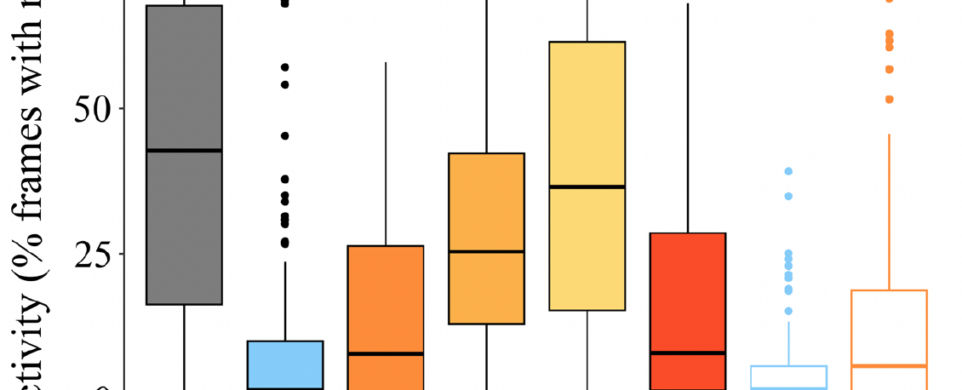
Artificial light at night (ALAN) has been spreading rapidly globally, disrupting animal physiology, behaviour and associated ecosystem processes. However, impacts on soil-dwelling animals that are nocturnally active aboveground remain under explored. Here, we examined these for the earthworm Lumbricus terrestris L., an ecosystem engineer that frequently surfaces at night. We recorded four types of L. terrestris nighttime surface behaviour, including overall surface activity, and three finer categories: risk exploration before surfacing, foraging and over-surface exploration. One experiment (controlled temperature-room-based) tested these behavioural responses to seven ALAN levels, whilst another (field-based) investigated whether behavioural responses can consequently affect litter removal and soil respiration. In the controlled-temperature room, compared to darkness, L. terrestris significantly decreased their overall nighttime foraging at ALAN levels of 10 lx and above, with these negative ALAN effect sizes increasing with light intensity. With more risk exploration before surfacing, L. terrestris still showed greatly reduced foraging activity at the 10 lx ALAN level in the field. However, such altered behaviour did not cause clear patterns in either litter removal or soil respiration. Our results confirm that 10 lx ALAN (or potentially lower) is effective in disrupting L. terrestris nighttime surface behaviour, but this may have limited impacts on short-term C cycling.
Recovering farmland nature

Baker, D.J., Nye, C., Wheeler, R., Masquelier, C., Binner, A., Gaston, K.J., Heard, M.S., Lobley, M., Smith, D. & Maclean, I.M.D. 2025. Aligning strategic and participatory approaches to agri-environment scheme design and implementation to enhance nature recovery outcomes. People and Nature 7, 329-345.
1. Nature recovery requires the provisioning of resources in the right place and in sufficient quantities to support wildlife populations and improve ecological processes. Agri-environment schemes (AES) have been a major mechanism for delivering environmental management across EU-farmed landscapes, but measured benefits to nature are often negligible in large part due to a lack of strategic spatial targeting of management actions.
2. As an example, AES in England are often delivered using a participatory strategy, typically at individual farm scale, with types of management agreements and uptake reflecting the business model and interests of each farm. However, this implementation model can result in poorly distributed conservation resources and, consequently, a failure to recover nature across larger scales, even if individual agreements are delivered well.
3. Achieving effective, large-scale nature recovery through AES requires aligning its implementation with spatially targeted approaches that prioritise specific conservation goals. We discuss the rationale for, and major barriers to, aligning AES design and implementation to these approaches. We then highlight how, through the framework of systematic conservation planning, both the strategic and participatory components of AES could be aligned better to enhance nature recovery outcomes.
4. To ensure AES help achieve nature recovery goals, clear and measurable targets must be set with the type and spatial configuration of actions designed to enable meeting targets. Strategic spatial targeting must also be carried out with the implementation phase in mind, accounting for socio-economic opportunities and barriers to engagement and acknowledging that uncertainties around farm-scale implementation mean plans must be adaptable. Participatory approaches for AES design and implementation that support the delivery of spatially targeted management actions are required, most notably by facilitating collaboration or cooperation across farm holdings.
5. For AES to contribute effectively to nature recovery goals, aligning strategic and participatory approaches in its design and implementation is crucial. This requires uniting knowledge across disciplines and cultures and ensuring that information is shared to support progressive refinement of scheme design and guidance towards achieving overall nature recovery goals.
Shaping connection to nature

Soga, M. & Gaston, K.J. 2025. Cross-country variation in people’s connection to nature. One Earth 8, 101194.
Enhancing pro-nature behavior across societies is a key sustainability challenge, with people’s connection to nature recognized as a primary driver. Understanding how this connection varies across countries and regions and the factors influencing it is, therefore, a crucial step in addressing this challenge. However, this remains poorly understood due to the scarcity of cross-country studies, particularly outside the Global North. Using data from a survey spanning 23 countries worldwide, we identified substantial variations in individuals’ psychological (cognitive) and physical (experiential) connections to nature. These differences are influenced by several country-level factors, such as socioeconomic development and the extent of cultivated land, alongside individual-level factors like education level and social status. The broad variation in connection to nature revealed by our study provides valuable insights for predicting large-scale spatial patterns of this connection and identifying regions where targeted efforts are most needed to strengthen it effectively.