Functioning at night

Cox, D.T.C., Baker, D.J., Gardner, A.S. & Gaston, K.J. 2023. Global variation in unique and redundant mammal functional diversity across the daily cycle. Journal of Biogeography 50, 629-640.

Aim: Organisms primarily influence ecosystems through their functional traits when they are physically active. Following the nocturnal bottleneck, the expansion of mammals into the daytime expanded mammalian functional diversity (FD), however there is also notable overlap in trait space across diel niches leading to redundant FD. We explore how the unique and redundant contribution of each diel niche varies spatially and in relation to natural variation in light and temperature.

Location: Global.

Taxon: Extant mammals.

Methods: Based on five major functional traits (body mass, litter size, diet breadth, foraging strata, habitat breadth) for 5033 extant terrestrial mammals, we determine biogeographical variation in nocturnal, crepuscular, cathemeral and diurnal FD. We calculate the proportion of mammalian FD that is unique to each diel niche, and the proportion that is redundant across the daily cycle.

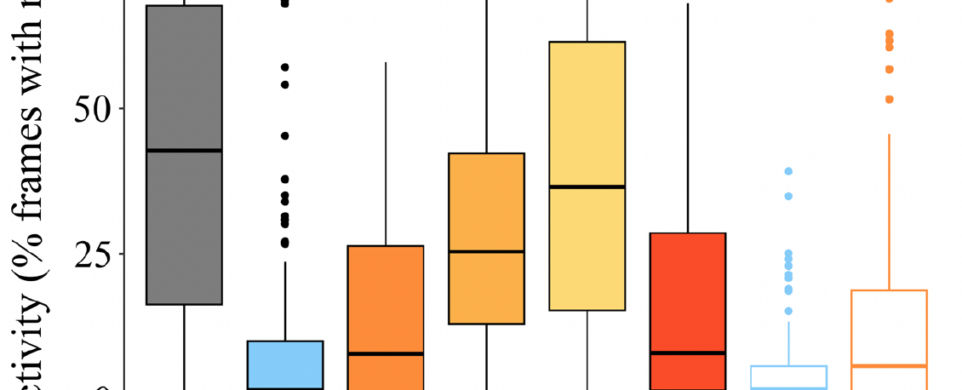
Results: The diversification of mammals into the daytime resulted in the creation of new FD (28.5% of FD is not nocturnal; Lower Quartile 17.3%; Upper Quartile 38.2%). Most of this expansion occurred at higher latitudes where uniquely cathemeral FD dominates (>55°N, 41.1% of mammalian FD; Lower Quartile 33.3%, Upper Quartile 53.6%), associated with fewer hours of biologically useful moonlight and daylight. Where there are more hours of biologically useful daylight, unique diurnal FD is common. However, more than half of non-nocturnal FD is redundant, increasing ecosystem stability as different species carry out similar functions at different times of day, and suggesting that many mammals have not diversified far from their nocturnal ancestors.

Main conclusions: Over much of the land surface more than a half of FD only occurs at night, underscoring the importance of nocturnal mammals for ecosystems. Understanding diel variation in FD not only informs on community structure and ecosystem function but also on ecosystem functional persistence in the Anthropocene, with pressures at night being particularly concerning.


Losing the natural night

Gaston, K.J., Gardner, A.S. & Cox, D.T.C. 2023. Anthropogenic changes to the nighttime environment. BioScience 73, 280-290.

How the relative impacts of anthropogenic pressures on the natural environment vary between different taxonomic groups, habitats, and geographic regions is increasingly well established. By contrast, the times of day at which those pressures are most forcefully exerted or have greatest influence are not well understood. The impact on the nighttime environment bears particular scrutiny, given that for practical reasons (e.g., researchers themselves belong to a diurnal species), most studies on the impacts of anthropogenic pressures are conducted during the daytime on organisms that are predominantly day active or in ways that do not differentiate between daytime and nighttime. In the present article, we synthesize the current state of knowledge of impacts of anthropogenic pressures on the nighttime environment, highlighting key findings and examples. The evidence available suggests that the nighttime environment is under intense stress across increasing areas of the world, especially from nighttime pollution, climate change, and overexploitation of resources. 


Shining a light on fear

Jolkkonen, J., Gaston, K.J. & Troscianko, J. 2023. Artificial lighting affects the landscape of fear in a widely distributed shorebird. Communications Biology 6, 131.

Fear influences almost all aspects of a prey species’ behaviour, such as its foraging and movement, and has the potential to cause trophic cascades. The superior low-light vision of many predators means that perceived predation risk in prey is likely to be affected by light levels. The widespread and increasing intensity of artificial light at night is therefore likely to interfere with this nocturnal visual arms race with unknown behavioural and ecological consequences. Here we test how the fear of predation perceived by wintering Eurasian curlew foraging on tidal flats is influenced by lighting. We quantified flight initiation distance (FID) of individuals under varying levels of natural and artificial illumination. Our results demonstrate that FID is significantly and substantially reduced at low light levels and increases under higher intensity illumination, with artificial light sources having a greater influence than natural sources. Contrary to the sensory-limitation hypothesis, the curlews’ unwillingness to take flight in low-light appears to reflect the risks posed by low-light flight, and a desire to remain on valuable foraging grounds. These findings demonstrate how artificial light can shape the landscape of fear, and how this interacts with optimal foraging decisions, and the costs of taking flight.


Making connections

Soga, M. & Gaston, K.J. 2023. Global synthesis reveals heterogeneous changes in connection of humans to nature. One Earth 6, 131-138.

The connection that individuals have with nature impacts their well-being and their support for pro-nature policies. While it is generally believed that the connection between humans and nature is decreasing, the extent of this trend is uncertain. Here, we present a global analysis of the temporal changes in people’s psychological and physical connections to nature. Using a systematic review protocol, we identified 71 articles consisting of 100 case studies. Most of these studies used cross-sectional, rather than longitudinal, approaches, which examine the connection to nature among people of different ages. The literature we reviewed indicates that there has been a decline in human connection to nature over time. However, the magnitude of changes in nature connection varied by geographic and socio-economic settings, with some studies showing an increasing trend. These findings suggest that there are opportunities to limit and reverse ongoing disconnection of humans from nature where it does occur.


Horizon scanning

Sutherland, W.J., Bennett, C.., Brotherton, P.N.M. Butterworth, H.M., Clout, M.N., Côté, I.M., Dinsdale, J., Esmail, N., Fleishman, E., Gaston, K.J., Herbert-Read, J.E., Hughes, A., Kaartokallio, H., Le Roux, X., Lickorish, F.A., Matcham, W., Noor, N., Palardy, J.E., Pearce-Higgins, J.W., Peck, L.S., Pettorelli, N., Pretty, J., Scobey, R., Spalding, M.D., Tonneijck, F.H., Tubbs, N., Watson, J.E.M., Wentworth, J.E., Wilson, J.D & Thornton, A. 2023. A global biological conservation horizon scan of issues for 2023. Trends in Ecology and Evolution 38, 96-107.

We present the results of our 14th horizon scan of issues we expect to influence biological conservation in the future. From an initial set of 102 topics, our global panel of 30 scientists and practitioners identified 15 issues we consider most urgent for societies worldwide to address. Issues are novel within biological conservation or represent a substantial positive or negative step change at global or regional scales. Issues such as submerged artificial light fisheries and accelerating upper ocean currents could have profound negative impacts on marine or coastal ecosystems. We also identified potentially positive technological advances, including energy production and storage, improved fertilisation methods, and expansion of biodegradable materials. If effectively managed, these technologies could realise future benefits for biological diversity.


Multiple environmental consequences of artificial lighting

Gaston, K.J. & Sánchez de Miguel, A. 2022. Environmental impacts of artificial light at night. Annual Review of Environment and Resources 47, 373-398.

The nighttime is undergoing unprecedented change across much of the world, with natural light cycles altered by the introduction of artificial light emissions. Here we review the extent and dynamics of artificial light at night (ALAN), the benefits that ALAN provides, the environmental costs ALAN creates, approaches to mitigating these negative effects, and how costs are likely to change in the future. We particularly highlight the consequences of the increasingly widespread use of light-emitting diode (LED) technology for new lighting installations and to retrofit pre-existing ones. Although this has been characterized as a technological lighting revolution, it also constitutes a revolution in the environmental costs and impacts of ALAN, particularly because the LEDs commonly used for outdoor lighting have significant emissions at the blue wavelengths to which many biological responses are particularly sensitive. It is clear that a very different approach to the use of artificial lighting is required. [Image from Earth Science and Remote Sensing Unit, NASA Johnson Space Center]


Colouring Europe by night

Sánchez de Miguel, A., Bennie, J., Rosenfeld, E., Dzurjak, S. & Gaston, K.J. 2022. Environmental risks from artificial nighttime lighting widespread and increasing across Europe. Science Advances 8, eabl6891.

The nighttime environment of much of Earth is being changed rapidly by the introduction of artificial lighting. While data on spatial and temporal variation in the intensity of artificial lighting have been available at a regional and global scale, data on variation in its spectral composition have only been collected for a few locations, preventing variation in associated environmental and human health risks from being mapped. Here, we use imagery obtained using digital cameras by astronauts on the International Space Station to map variation in the spectral composition of lighting across Europe for 2012–2013 and 2014–2020. These show a regionally widespread spectral shift, from that associated principally with high-pressure sodium lighting to that associated with broad white light-emitting diodes and with greater blue emissions. Reexpressing the color maps in terms of spectral indicators of environmental pressures, we find that this trend is widely increasing the risk of harmful effects to ecosystems.[Image from Earth Science and Remote Sensing Unit, NASA Johnson Space Center]


Losing who does what when

Cox, D.T.C., Gardner, A.S. & Gaston, K.J. 2022. Global and regional erosion of mammalian functional diversity across the diel cycle. Science Advances 8, eabn6008.

Biodiversity is declining worldwide. When species are physically active (i.e., their diel niche) may influence their risk of becoming functionally extinct. It may also affect how species losses affect ecosystems. For 5033 terrestrial mammals, we predict future changes to diel global and local functional diversity through a gradient of progressive functional extinction scenarios of threatened species. Across scenarios, diurnal species were at greater risk of becoming functionally extinct than nocturnal, crepuscular, and cathemeral species, resulting in deep functional losses in global diurnal trait space. Redundancy (species with similar roles) will buffer global nocturnal functional diversity; however, across the land surface, losses will mostly occur among functionally dispersed species (species with distinct roles). Functional extinctions will constrict boundaries of cathemeral trait space as megaherbivores, and arboreal foragers are lost. Variation in the erosion of functional diversity across the daily cycle will likely profoundly affect the partitioning of ecosystem functioning between night and day.


Bites, stings and phobias

Soga, M. & Gaston, K.J. 2022. The dark side of nature experience: typology, dynamics and implications of negative sensory interactions with nature. People and Nature, online early.

1. The human health benefits of direct sensory interactions with nature (hereafter direct human–nature interactions) are increasingly recognised. However, these interactions can also have various negative health and well-being impacts on people, some of which may be severe. Compared to positive ones, there has been relatively little investigation of such negative direct human–nature interactions beyond the medical literature, and what has been done is widely scattered across disciplines.

2. Here, we provide an overview of the typology, characteristics and dynamics of negative direct sensory interactions with nature and suggest management implications and future research directions.

3. We highlight the breadth of forms that negative direct human–nature interactions occur, and evidence that the incidences of some have recently grown rapidly in many parts of the world.

4. Our review also suggests that more intense negative direct human–nature interactions can sometimes occur simultaneously or sequentially with more positive ones, and there may be trade-offs between the two.

5. Such serious implications highlight the importance of focusing research and public policy on improving the understanding of negative direct human–nature interactions, taking a more balanced view of the benefits and costs of nature experiences, and developing appropriate mitigation strategies.


Nature & social cohesion

Oh, R.R.Y., Zhang, Y., Nghiem, L.T.P., Chang, C.-C., Tan, C.L.Y., Quazi, S.A., Shanahan, D.F., Lin, B.B., Gaston, K.J., Fuller, R.A. & Carrasco, R.L. 2022. Connection to nature and time spent in gardens predicts social cohesion. Urban Forestry and Urban Greening 74, 127655.

A person’s health and wellbeing are contingent on the amount of social support that they receive. Similarly, experiencing nature has been shown to improve people’s health and wellbeing. However, we do not know how relationships between social cohesion, nature experiences and nature connection could interrelate and vary across different types of urban green spaces, and in non-Westernised cultures. We conducted a study on 1249 residents in Singapore, a tropical city-state, and measured three dimensions of social cohesion (i.e. general social cohesion; trust and sense of community; and social interactions), various types of nature experiences (i.e. amount of green space around one’s residence; frequency and duration of urban green space visits; frequency and duration of visits to gardens), and three dimensions of one’s connection to nature: self-identity with nature, desire to experience nature, and environmental concern (using the nature relatedness scale). We found that people who strongly identify with nature, who enjoy being in nature, and who had more frequent gardens visits were more likely to have a stronger sense of social cohesion across two dimensions. However, those with stronger environmental concern reported an overall weaker sense of social cohesion, possibly due to the perception that society’s contributions to conserve environmental problems was insufficient. Further, people who gardened more frequently were also more likely to visit green spaces, self-identify with nature and exhibit a stronger desire to experience nature. We propose that strategies targeted at encouraging people to engage in nature-related, collaborative activities at the local community level, such as spending time in local gardens, will increase urban residents’ daily nature experiences and its associated benefits such as improving social cohesion.